


Which System Is Good for Route Planning? It Depends on the Driving
The best system for route planning depends on what your vehicles drive for. If you deliver goods, a transport and route optimization system is the right choice. If you need to keep track of a vehicle fleet, a fleet management system fits better. If your employees drive out to customers to carry out tasks, a field service management platform with built-in route planning is usually the best choice, because the route has to be based on the tasks, the skills required and the time spent at the customer. That is the type of system Microbizz is: a Danish field service management platform for task and project management for companies with employees on the road.
Three types of driving, three types of system
"Route planning" covers very different needs. That is why it makes sense to start with the driving, not with the system.
Goods transport and distribution
Here, the delivery is the job. The vehicle has to reach many stops, the goods have to fit in the vehicle, and the customer has to receive the delivery within a time window. Transport and distribution systems are built for exactly that: many stops, load capacity, driving time and proof of delivery. They are the right choice for hauliers, wholesalers and courier companies.
Fleet management and mileage logs
Here, the focus is the vehicles. Where are they, how far do they drive, and what do they cost? Fleet management systems typically use GPS in the vehicles to give an overview of location, mileage and driving logs. They rarely plan the work itself, but they give a good picture of the fleet.
Service driving and technician visits
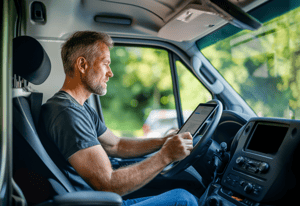
Here, the driving is not the goal but the way to the task. A technician, a fitter or a cleaning team has to reach the right customer with the right skills, carry out the task and register time and materials afterwards. So the route depends on which tasks are planned, how long they take and who can do them.
This is the situation route planning in Microbizz is built for. The system takes the day's tasks from task management, with addresses, deadlines, duration and skill requirements, and calculates the routes based on location, time windows and priority. The optimized route goes straight into the employee's calendar in planning, and the technician sees the day's sequence in the app. If an urgent task comes in, the planner can see the employees' positions via GPS and give the task to the best placed person.
Brunata uses route planning for around 50,000 ad hoc tasks a year, spread across 105 service technicians. According to their planner, all tasks can be put in at once, and the system then creates the plan.
How to find out which type of system you need
Do you earn money on the delivery or on the task at the customer?
If it is the delivery you invoice, you are looking for a transport system. If it is the work at the customer you invoice, route planning has to be connected to the tasks, and then you need a field service management platform.
Does the route have to consider more than distance?
The shortest route does not help if the technician lacks the right certification, or a task with a deadline ends up last in the day. When skills, task duration and customer agreements matter, the system has to know the tasks, not just the addresses.
Where should the data go once the driving is done?
In service driving, the route is the first step. Afterwards, time has to be registered, materials recorded, and an invoicing basis and payroll basis created. In Microbizz, time and material registration is part of the route, so the employee can register time and close the task in the app, and the data can be used directly for invoicing and payroll.
Do you have both types of driving?
Some companies both deliver goods and carry out service. Then it can make sense to use two systems, one for distribution and one for the service tasks. What matters is that each type of driving is planned in the system that understands it.
What it looks like across industries
Contractors and tradespeople plan driving between building sites and customers. Service companies plan short service visits and longer tasks with fast response times. Utilities coordinate fitters across large geographical areas, for both planned service and emergencies. In facility management, fixed routines and ad hoc tasks across buildings have to be combined in one plan.
Frequently asked questions about route planning systems
Which system is good for route planning in service companies?
For service companies, a field service management platform with built-in route planning is usually the best choice, because the route is based on the same tasks, skills and time registrations as the rest of the operation.
What is the difference between route planning and fleet management?
Route planning decides who drives where and in which order. Fleet management gives an overview of the vehicles, for example location, mileage and driving logs. Many companies need both, but they are two different jobs.
Can the route change after the employees have left?
Yes. In Microbizz, the route plan is updated automatically when a task is added or changed, and the employee sees the new plan in the app. The planner can also adjust routes and assign tasks manually.
Can you plan routes more than a day ahead?
Yes. Route planning in Microbizz can plan for one day, one week or one month ahead, which is useful for fixed service agreements and recurring tasks.
How does the system calculate the route?
The system works through many possible combinations of tasks, addresses, time windows and employees and finds a plan with an eye on time, driving and costs. You can book a demo and see it with your own tasks.