







Which Software Do Utilities Use for Field Service?
Utilities typically use several systems side by side: GIS and a pipeline register for the network, SCADA-type systems (SRO in Danish) for operations and monitoring, a billing system for consumption and customers, an accounting system, and a system for planning and documenting work in the field. The last one is field service software. Microbizz is a Danish field service management platform for task and project management, used by, among others, utilities. This industry guide gives an overview of what each type of software does and where field service software fits in.
What types of software do utilities use?
GIS and pipeline register
GIS is used to record the network: where pipes, valves, and installations are, and how they connect. The pipeline register is used to document lines, so contractors can avoid damaging them. Both are built to describe the network, not to plan the technicians' day.
SRO and operations monitoring
SRO stands for control, registration, and monitoring. The system keeps an eye on installations and can show that something is wrong. Who fixes the fault, when, and what was done has to be recorded somewhere else.
Billing and accounting
The billing system handles customers, meter data, and billing for consumption. The accounting system takes care of bookkeeping and other invoicing. Both depend on the information from the field being correct and complete.
Field service software
Field service software brings together what happens in the field: tasks, planning, time and materials, documentation, and the invoicing basis, for both the office and the technicians. It complements the other systems instead of replacing them.
Spreadsheets and paper
Many utilities still use spreadsheets and paper slips for tasks and documentation. That often leads to several versions of the same list, and tasks and documentation can get lost along the way.
Where does field service software fit in?
What does field service software do in utilities?
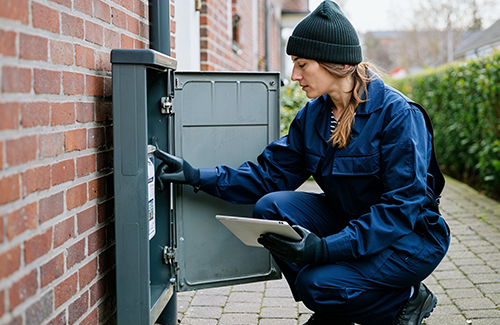
Microbizz is used to plan fixed, recurring, and urgent tasks and to plan routes, so technicians reach more customers in less time. Installers get task details and forms in the app, which also works offline, and document with photos and quality assurance forms. If an installer registers a deviation, a new task can be created automatically. Time and materials go on to the invoicing basis, and customers and partners can follow status through the extranet.
How does it connect to the other systems?
Through integrations. Microbizz's utility pages mention, among others, Outlook, a billing system, an accounting system, and Power BI, as well as API, plugins, and standard integrations. GIS and SRO are not described on the pages, so ask about them if they matter to you.
Example: DIN Forsyning
DIN Forsyning, which has over 60,000 meters, used to handle tasks on paper and in Excel. Today the meters are divided into zones, which are set up as tasks in Microbizz. Installers fill in forms and take photos when replacing a meter, and the meter data is sent directly to the billing system.
Water and heat or cable and fiber?
The needs are not the same. In water and heat, it is often about meter replacement, preventive service, and mandatory inspections. In cable and fiber, projects often consist of hundreds of small tasks, where subcontractors need to be coordinated and documentation and invoicing have to keep pace.
Frequently asked questions about software for utilities
Can field service software replace GIS, SRO, or the billing system?
No. The three systems solve other tasks: recording the network, monitoring installations, and billing for consumption. Field service software manages the work in the field and passes information on to the other systems.
Can field service software connect to the billing system?
Yes, in the cases described on Microbizz's pages. DIN Forsyning sends meter data directly to its billing system. What is possible at your company depends on your system, so talk to Microbizz about it.
Is field service software only for large utilities?
No. According to a customer statement on Microbizz's utility page, the platform suits both large and small companies. DIN Forsyning has over 60,000 meters.
How do we choose software for fieldwork?
Start by mapping which tasks are in spreadsheets and on paper today and what you need to be able to document. Then ask about a mobile app with offline function, forms, collaboration with subcontractors, and integration with your billing and accounting systems. You can book a demo and see how it looks with your own tasks.