







Field Service Compliance in Utilities: Requirements and What FSM Solves
In the utility sector, compliance in practice comes down to three things a system must support: documentation of what was done, when, and by whom; procedures that are followed every time; and secure handling of data at the vendor. Field service software solves the first two in daily work, because the documentation is created on the task while the technician works. Software alone doesn't make a utility compliant, though, because the requirements and the responsibility sit with the company itself.
What does compliance require of the system in a utility company?
The requirements vary with the type of utility, its size, and the authority involved, so it's important to check what applies to you. Below are the three areas a system typically needs to support.
Documentation and traceability
A utility needs to be able to show what was done, when, and by whom, long after the task was completed. That's hard if the information sits in paper slips, emails, and spreadsheets. The system should store the documentation on the task itself, with timestamp and notes.
Procedures and control
Many waterworks typically operate under control programs that the municipality issues decisions on. That requires checks to be carried out following a fixed procedure and to be documentable afterwards. The system should therefore be able to link checklists and forms to the right tasks and register deviations.
IT and cyber security
Water and wastewater utilities fall under the NIS2 Act in Denmark. According to the Danish Environmental Protection Agency, they must protect their network and information systems with appropriate technical, operational, and organizational measures. If a utility uses an external vendor for its operations system, it's natural to ask questions about the vendor's security.
What does field service software solve in practice?
Documentation is created on the task
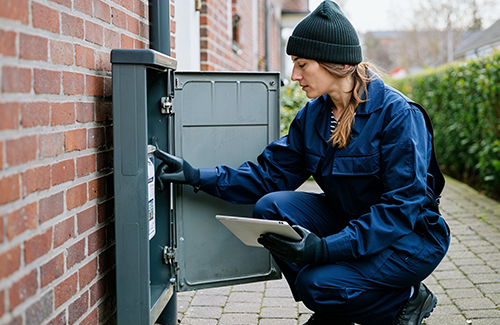
In Microbizz, the technician documents continuously in the mobile app with photos, checklists, and notes. The customer can sign on the technician's device, and the report is saved with signature, timestamp, and notes. The work is documented in real time, so it's clear what was done, when, and by whom.
Procedures are followed every time
In quality assurance, you can create standardized or custom forms. The automatic form function links them to tasks, and employees get reminders to fill them in. That makes it easier to follow the same procedure every time, regardless of who carries out the task.
Deviations become tasks
If the technician registers a deviation in the form, a new task is created automatically and the quality manager is notified. The deviation is followed up on, instead of sitting as a remark in a report.
Overview and sharing
Management can follow the status of quality checks in real time on dashboards, and reports and documentation can be shared with customers and partners through the extranet. On the utility page there are customer cases from utility companies such as DIN Forsyning, which manages over 60,000 meters, and Munck Forsyningsledninger.
What software doesn't solve
Software can't interpret legal requirements, decide the content of a control program, or replace a utility's own IT security policy. That remains the company's responsibility. What software can do is make sure that what has been decided gets done and documented the same way every time.
Frequently asked questions about field service and compliance in utilities
Does field service software make a utility compliant?
No. Software supports documentation, procedures, and overview, but the responsibility for meeting the requirements lies with the utility. A good system makes it easier to show what has been done.
What should we ask a software vendor?
Ask about hosting and data location, certifications, independent auditor's reports, uptime and backup, and a data processing agreement. Microbizz states that its hosting centers are ISO 27001 certified, that European operations are hosted from Frankfurt, and that an ISAE 3402 Type 2 report from an external auditor is available on request. Read more about how we protect data.
Can customers and partners see the documentation?
Yes. Through the extranet, customers and subcontractors can follow status and documentation, and tasks can be shared with external partners.
Do the same requirements apply to water, heating, and fiber?
No. The requirements vary with the type of utility and its size, and the NIS2 Act covers, among others, water and wastewater utilities. Ask your industry association, authority, or adviser what applies to you, and then use the system to document that it's being followed.